
It is now twenty years since I joined Limuru Country Club—unbelievable! I can still remember that evening at the old colonial clubhouse when I first arrived to meet my uncle. It smelt of old, smoky wood and tea. There was a membership offer for 50K, and he informed me that he had already picked up the application forms; I was to join the club. He said that to be successful, I needed to hang out with successful people. Maybe he was concerned that I was moving too slowly, hehe. I had two instructions on that day: to be at Limuru by 6.00 pm that Wednesday and to carry my chequebook. You can tell it was more of a directive than a request. Seeing that I was well brought up, I complied.
When I showed up, my uncle introduced me to specific members and had my form signed. I later learnt that they were members of the balloting committee—on which I would serve a few years later. They were the ones to decide if I was ‘clubbable’, hehe. Luckily, I was found fit. Limuru has been a major part of my life and identity since then. It has grown my leadership and social capital to levels I never thought possible. After joining in 2006, six years later I found myself serving as golf captain and club director by 2012. After another six years, I was the Chairman of the national body, the Kenya Golf Union—courtesy of Limuru proposing me to represent not just our club, but also the entire golfing fraternity in the country.
My buddies and I have played many rounds on that wonderful golf course and spent many evenings enjoying a drink, a dance, or just warming ourselves at the fireplace. I remember with nostalgia the midnight putting competitions on the 18th green by the clubhouse. Just walking down memory lane has made me miss our old clubhouse, which burnt to the ground two years ago. But we are rising again, pole pole. Fortunately, the memories didn’t go up in flames with our beloved clubhouse.
For years, we were the youngins. I would go to Limuru and often play with my uncle’s friends and age mates. The stories of Limuru in the 70s, 80s and 90s fascinated me sana; I would lean in with curiosity to learn more of our history. Stories such as when the first black members joined, when the course was redesigned, and how the club used to interact with the surrounding community. History is a beautiful thing, especially when passed over a round of golf. Those wazees clearly built the foundation for us to stand on and enjoy the Limuru we have today.
As much as the fire was painful, perhaps it was the blazing sign that the time has come for my generation to become the foundation for the next crop of younger members to stand on. I don’t frequent Limuru as much as I’d like, but the last few visits have confirmed that it’s time to pass the mantle. Due to the cool vibe Limuru has always been known for, many younger folks have taken up membership and are the resident hecklers (and leaders, too). I feel like some of the new members view me as a visitor when I go there.
Some time back, I caught a game with my pal Davy. Upon teeing off on the first hole, I realised one of the ladies on my team was unknown to me. We introduced ourselves, and she asked me where I played my golf. When a golfer asks you that, it often means you either are a visitor to that club, or have just begun playing golf. Before I could respond, my caddie (who knew me from way back) pointed toward my ball, calling out, “Ndio ile ball, Chairman.” The lady, now wearing a perplexed look, asked me what I was the chairman of. I politely informed her of my journey at Limuru. After that conversation, it was clear that the time had come for my peers and me to start moving to the back of the room. There is clearly a new sheriff in town.
Now we are those old men and women talking about the history of the club. Imagine that. I never would have thought that this time would come. Life can deceive us into believing that we will be young forever, until such reminders jolt us back to reality. It has been a great run at Limuru over the last two decades, and I can’t thank my uncle enough for forcing me to join this great club. We could also say that I’m reaping the rewards of obeying my seniors, hehe. A point for the younger readers to note hehe.
Folks, have you ever been part of an organization or team over a long period of time that leaves an indelible mark on you? What did that feel like? That has been Limuru for me. But it is equally important to know when to slide from the front row to the back, and let others take over. I enjoy being called ‘senior’ now, though it makes me sound older than I am, hehe. It feels good to offer counsel when approached and to allow myself to be led by younger, more energetic people. We often see things differently, but I’m learning to appreciate their way of doing things, giving them the benefit of the doubt, and speaking up respectfully when needed.
I wonder what my uncle and his peers thought of us when we were running the show fifteen years ago. I think that will be the topic of our next conversation as we walk those lush fairways. Giving up the reins does actually feel good, yet many leaders struggle to let go. Why is that? Whenever I meet my pals, we reminisce about the days gone by and all the fun times we had. Those stories will take a long time to tell because we built memories over twenty years that may take even longer to recollect and laugh about.
I think if we collect many memories from the good we do, and the impact we have on organisations and people, it becomes much easier to let go and hand over. Then we are left saying, “That was a good run,” with nothing left to go back and do. Knowing when to leave the stage ensures that the memories and friendships built over time are preserved, and carry us into the next season of our lives. Always remember to leave the room while they are still clapping, folks. And may the memories we make along the way keep us company. Thankfully, we are allowed to carry those with us when we exit the stage.
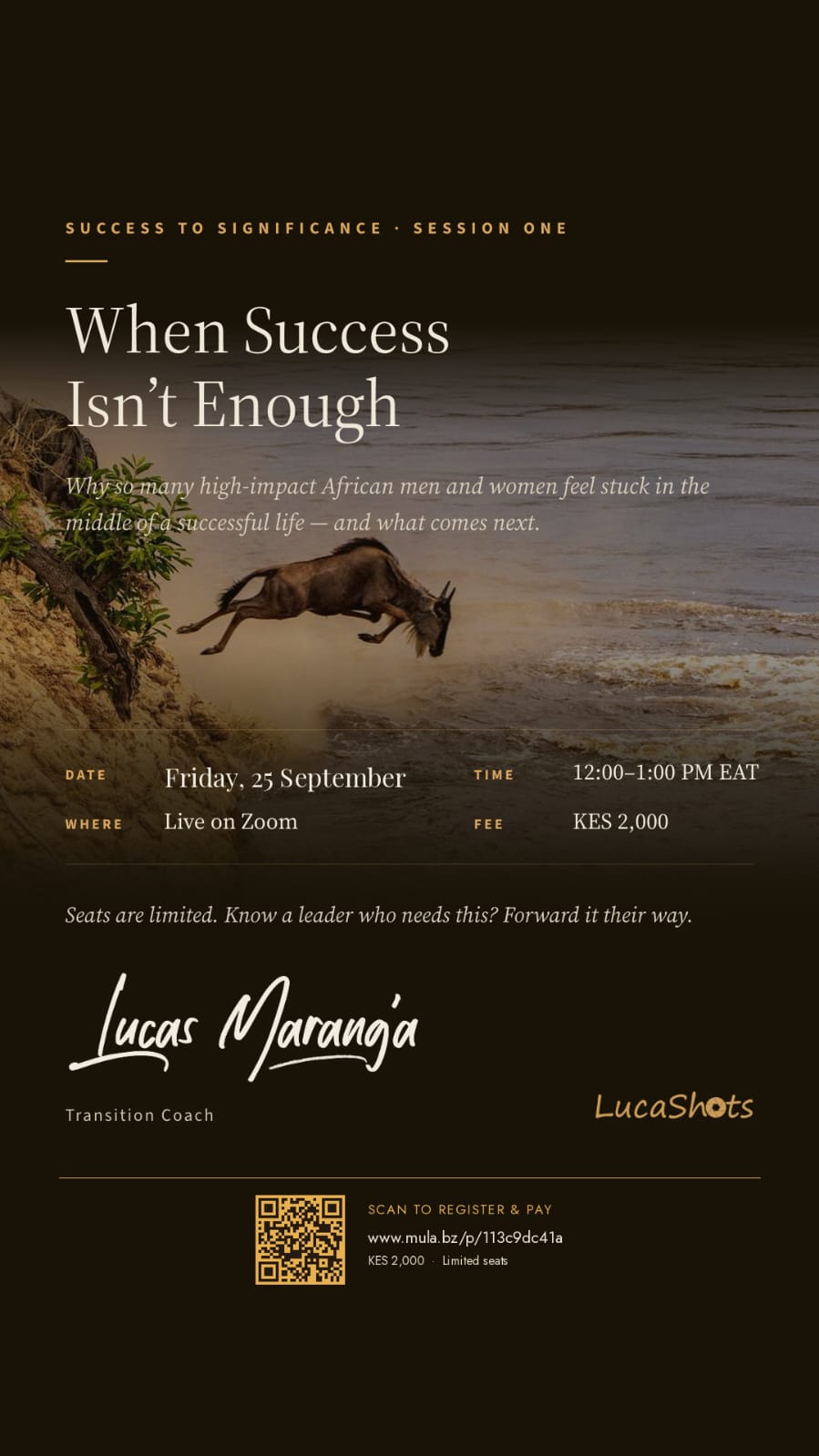
Success to Significance Webinar
You've built the career, the title, the reputation — everything success was supposed to give you. So why does it sometimes feel like something's still missing?That's exactly what we're unpacking in Webinar 1: When Success Isn't Enough, the opening session of my new Success to Significance series for African leaders in midlife. In one honest hour, we'll talk about the transition every high-achiever eventually faces — and how to cross it well.
Friday, 25th September12:00 – 1:00 PM (EAT)
Live on Zoom
KES 2,000
Seats are limited. Know a leader who needs this conversation? Forward it their way.
Register Here
Having made that transition a few times myself, I fully agree with you. It is liberating and leaves you with wonderful memories.
What a natural transition. Transitions can be a tad bit daunting, especially when one does much calculating. Sometimes it’s best done without overthinking. Faith over practicality.
”Leave the room while they are still clapping” powerful reminder that is. The saying that when we connect our dots backwards, then the present makes sense. Just connecting your dots Lucas back to that day of introduction now all makes sense. It was a journey planned out for you. Your obedience paid off! Am so proud to have a front row sit of this journey. Mob love.